Engineering Leadership · AI Strategy
What is AiDD and How Should Organisations Actually Adopt It?
AI-Driven Development isn’t a tool. It’s a mindset shift — and most companies are doing it backwards.
A Story You Might Recognise
Eighteen months ago, a mid-sized fintech firm decided to go all-in on AI. They bought GitHub Copilot licences for every engineer. They ran a two-hour workshop on prompt engineering. They sent a company-wide Slack message saying “We are embracing AI-first development.”
Six months later? Their velocity hadn’t improved. Their code quality had actually dipped. And half their senior engineers were quietly frustrated — spending more time reviewing AI-generated code that almost worked than they would have spent just writing it themselves.
The problem wasn’t the tools. The problem was they adopted AI like it was a software upgrade — install, restart, done. But AI-Driven Development isn’t a tool you plug in. It’s a fundamental change in how your organisation thinks about building software.
So First — What Actually Is AiDD?
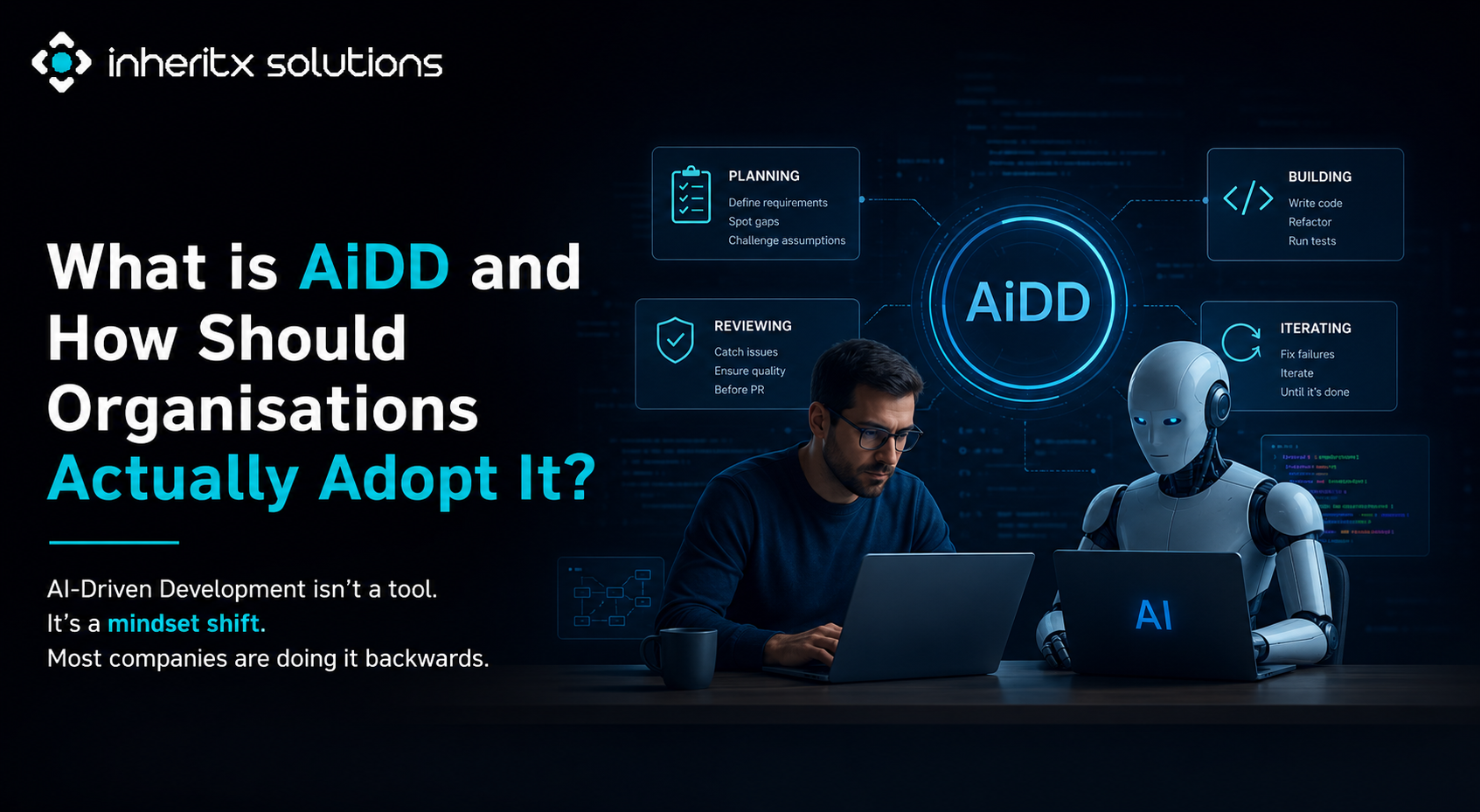
AiDD (AI-Driven Development) is a development methodology where AI is not a helper on the side — it’s an active participant in the entire software lifecycle. Not just autocomplete. Not just a smarter Stack Overflow.
We’re talking about AI involved across the full build cycle:
|
️
Planning
Helping define requirements, spot gaps, and challenge assumptions before a line of code is written.
|
⚙️
Building
Writing, refactoring, and testing code autonomously across multiple files and systems.
|
|
Reviewing
Catching issues, inconsistencies, and edge cases before humans even look at a PR.
|
Iterating
Running tests, reading failures, fixing them, and looping until the job is actually done.
|
The Workflow Shift
Before AiDD
Engineer gets a ticket → thinks through the solution → writes the code → tests it → submits a PR
↓
After AiDD
Engineer defines the outcome clearly → directs an AI agent to build it → reviews, steers, and approves → ships
Tools like Claude Code are the clearest example of this in practice today. It reads your entire codebase, plans across multiple files, runs your test suite, fixes failures, handles git workflows, and iterates until the job is done. It operates less like a tool and more like a tireless junior engineer who never needs context repeated twice.
Why Most Organisations Are Getting It Wrong
Most companies adopting AI right now are doing it for optics, not outcomes.
They’re measuring success by how many AI tools they’ve rolled out — not by whether those tools have actually changed how work gets done. They hand engineers a Copilot subscription, see a few functions get autocompleted faster, and call it an AI-first organisation.
That’s not AiDD. That’s AI-assisted typing.
The deeper problem is structural. Organisations haven’t changed:
- ✗ How they write requirements (vague tickets produce vague AI output)
- ✗ How they define done (AI needs clear success criteria to iterate toward)
- ✗ How they review code (reviewing AI output requires a different mental model)
- ✗ How they measure engineering productivity (lines of code is a useless metric now)
⚠️ You cannot pour AI into broken processes and expect transformation. You get faster broken processes.
The Right Way to Adopt AiDD
An honest roadmap through five deliberate stages.
Stage 1
Stop Treating AI as a Feature, Start Treating It as a Teammate
Engineers need to stop asking “how do I use this tool?” and start asking “how do I work with this collaborator?” That means learning to give context, not just commands.
</>
bad prompt vs good prompt
✗ Bad:  "write a login function"

✓ Good: "write a login function for a Node.js Express app,
         using JWT tokens, with refresh token support,
         following our existing auth middleware pattern
         in /src/middleware/auth.js"
What orgs should do: Run internal prompt engineering sessions — ongoing, practical, team-level learning. Not a one-off two-hour workshop.
Stage 2
Redesign Your Workflows, Not Just Your Tooling
Adding AI tools on top of existing workflows is why ROI is underwhelming. AiDD requires rethinking the workflow itself. If your tickets say “Build filter functionality for the dashboard” — that’s not enough information for a human, let alone an AI agent.
</>
ticket quality comparison
✗ Old ticket:
  Build filter functionality for the dashboard

✓ AiDD ticket:
  Build date-range + status filters for /dashboard/orders
  - Follow existing FilterBar pattern in /src/components/FilterBar
  - Acceptance: filters update URL params and persist on refresh
  - Edge cases: empty state, invalid date range, mobile viewport
  - Done when: all unit tests pass + QA sign-off on staging
What orgs should do: Audit your current workflow. Where are the handoffs? Where is context lost? Redesign those points with AI delegation in mind.
Stage 3
Redefine What Your Engineers Are Responsible For
This is the conversation most engineering leaders are avoiding. In an AiDD organisation, engineers are not primarily valued for how fast they write code. They are valued for:
| Problem Definition |
Understanding what actually needs to be built and why |
| Systems Thinking |
Making architecture decisions that AI cannot make alone |
| Judgment |
Knowing when the AI is confidently wrong |
| Orchestration |
Directing multiple AI agents working in parallel |
| Accountability |
Owning what ships, regardless of who wrote it |
What orgs should do: Have an honest conversation with your engineering team about how roles are evolving. Name it. Discuss it. Redesign job expectations accordingly.
Stage 4
Build a Culture of Verification, Not Blind Trust
Here’s a real risk nobody talks about enough: over-reliance. AI-generated code can look impeccable and be subtly wrong. It can pass your tests and fail your users. It can follow the pattern you described and miss the business logic you forgot to mention.
</>
review checklist for AI-generated code
When reviewing AI output, ask:

  ✓  Did it solve the right problem?
  ✓  Does this hold up at scale?
  ✓  Is there a hidden assumption that breaks in production?
  ✓  Does it match actual business logic — not just the ticket?
What orgs should do: Define clear human checkpoints. AI generates, humans verify. Ship nothing that hasn’t been understood — not just approved.
Stage 5
Measure the Right Things
If you’re still measuring by tickets closed or lines of code written, AiDD will confuse your metrics completely. An engineer who directed AI agents to build three major features and reviewed every output carefully will look less productive on a traditional scorecard.
| ❌ Stop measuring |
✅ Start measuring |
| Lines of code written |
Features shipped vs. planned |
| Tickets closed per sprint |
Defect rate post-release |
| Hours in IDE |
Time from problem definition to production |
| PR count |
Quality and maintainability of what ships |
What orgs should do: Redesign your engineering metrics before you scale AiDD. Otherwise, you’ll accidentally reward the wrong behaviours.
The Uncomfortable Truth at the End
AiDD is not coming. It’s here.
The organisations that figure this out — not just by buying tools, but by genuinely restructuring how they think, work, and measure success — are going to move at a speed that feels unfair to everyone else.
The gap between those two groups isn’t about budget. It isn’t about which tools they picked. It’s about whether leadership had the honesty to say: this changes everything — and then actually acted like it did.
“
The best engineers of the next decade won’t be the ones who resisted AI. They’ll be the ones who learned to think clearly enough to direct it.