Monorepo Architecture: A Must-Have Skill for Software Engineers in 2026
A few years ago, I thought multiple repositories were the cleanest way to organize projects. One repo per app, one repo per service, everything neatly separated. It felt organized — until it wasn’t.
Then came the duplicated utility functions copy-pasted across three different repos. The version mismatches between a shared UI library and the app that consumed it. The Friday afternoon where a backend API change broke the mobile app, and nobody found out until QA did. The CI pipelines that needed to be updated in five different places every time we changed a build step.
If any of that sounds familiar, you’re not alone. It’s one of the most common pain points in growing engineering teams, and it’s exactly the kind of problem monorepo architecture was built to solve.
That is why monorepo architecture is becoming one of the most valuable engineering skills in 2026.
What Is Monorepo Architecture?
At its core, monorepo architecture means storing multiple apps, packages, libraries, and services in a single repository, instead of scattering them across dozens of separate repos.
That doesn’t mean everything is one giant tangled mess. A well-structured monorepo is actually more organized than most polyrepo setups, because it enforces clear boundaries between apps and shared code — all while keeping everything versioned, tested, and deployed together.
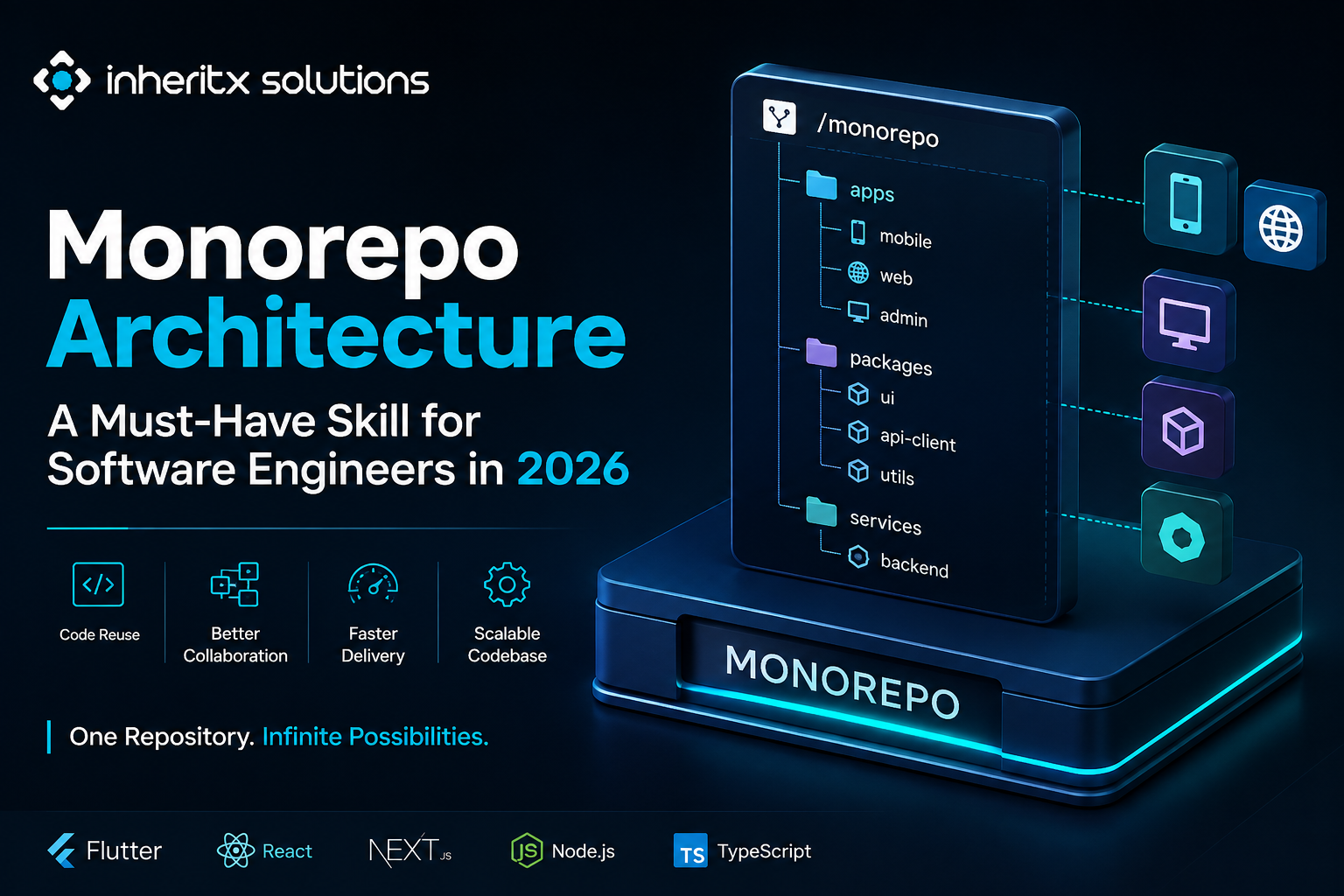
Here’s a simplified example of what a monorepo folder structure might look like:
repo/
├── apps/
│   ├── mobile/
│   ├── web/
│   └── admin/
├── packages/
│   ├── ui/
│   ├── api-client/
│   └── utils/
└── services/
    └── backend/
In this setup:
- apps/ contains your deployable products — mobile app, web app, admin dashboard.
- packages/ contains shared, reusable code — UI components, API clients, utility functions.
- ⚙️ services/ contains your backend services.
Contrast this with a polyrepo approach, where each of those folders would live in its own separate Git repository, with its own versioning, its own CI pipeline, and its own release cadence — often drifting out of sync with everything else.
⚖️ Monorepo vs Polyrepo
Neither approach is universally “better.” The right choice depends on your team size, product structure, and organizational boundaries. Here’s a balanced breakdown:
If you’re a small team building one product, this comparison might feel abstract. But once you’re maintaining a shared design system, an API client used by three apps, or a backend that multiple frontends depend on, the trade-offs become very real, very fast.
Why Monorepo Architecture Matters in 2026
A few industry shifts are pushing monorepo adoption from “nice to have” to “expected skill”:
- Full-stack product teams now routinely own mobile, web, and backend together — not separate teams working in isolation.
- Shared design systems need a single source of truth, not five copies drifting apart.
- AI-assisted development tools work far better with full repo context rather than fragments scattered across disconnected repos.
- ⚡ Faster release cycles demand atomic, cross-cutting changes that a polyrepo setup makes painfully slow.
- ️ Platform engineering teams are building internal tooling meant to be consumed across many apps at once.
- Products increasingly ship mobile + web + backend as one cohesive experience, not three disconnected codebases.
Companies like Google, Meta, Microsoft, and X/Twitter have long relied on large-scale monorepo-style workflows internally, and the tooling that used to be exclusive to big tech — build caching, affected-only testing, dependency graphs — is now available to teams of any size through open-source tools.
✨ Top Benefits of Learning Monorepo Architecture
1. Code Reuse
Instead of publishing an internal npm package every time a utility function changes, you just import it directly. A formatCurrency() function in packages/utils is instantly available to your web app, admin dashboard, and backend — no publish step required.
2. Consistent Dependencies
No more “it works on the mobile repo but breaks on web because they’re on different versions of the same library.” One workspace config means one source of truth for versions.
3. ⚛️ Atomic Changes
Need to update an API contract and the frontend that consumes it? In a monorepo, that’s one commit, one PR, one review — instead of coordinating merges across two or three separate repositories.
4. Faster Developer Onboarding
New engineers clone one repo and can see the entire system — instead of hunting through a dozen disconnected repos trying to piece together the architecture.
5. ️ Better CI/CD Optimization
Modern monorepo tools can detect exactly which apps and packages were affected by a change and only rebuild and retest those — turning a 40-minute pipeline into a 4-minute one.
6. Improved Collaboration
When your API team and your mobile team share a repo, code review naturally becomes cross-functional. Engineers see how their changes ripple across the whole product.
7. Easier Refactoring at Scale
Renaming a shared type or restructuring a shared component becomes a single, traceable change — your tooling can find every usage across the entire codebase at once.
A Flutter Developer’s Perspective
If you’re a Flutter developer, monorepo architecture solves problems you’ve probably run into more than once.
A typical Flutter monorepo structure might look like this:
repo/
├── apps/
│   ├── mobile_app/
│   └── admin_app/
├── packages/
│   ├── shared_widgets/
│   ├── shared_models/
│   ├── localization/
│   └── api_client/
Here’s why this matters for mobile teams specifically:
- Single source of truth — your mobile app and admin app share the same models and business logic, so they never drift out of sync.
- Reusable widgets — a custom button, form field, or theme component lives in one place and gets used everywhere.
- Shared localization — translation strings maintained once, used across every app in the repo.
- Consistent themes — brand colors, typography, and spacing tokens stay identical across mobile and admin experiences.
- Easier release management — coordinate a shared package update across both apps in a single PR.
Tools like Melos were built specifically to make Dart and Flutter monorepos manageable, handling versioning, publishing, and running scripts across multiple packages at once.
Popular Monorepo Tools in 2026
You don’t need to build monorepo tooling from scratch — the ecosystem has matured significantly. Here’s a snapshot of the most widely used tools:
For most small-to-mid-size teams starting out, Turborepo or pnpm workspaces offer the gentlest learning curve. For enterprise-scale, polyglot systems, Bazel or Nx tend to be the go-to choices.
⚠️ Challenges You Should Know
Monorepos aren’t magic — they come with real trade-offs:
- Large repository size — as the codebase grows, clone and checkout times can slow down.
- ⏳ Longer clone times — especially for engineers with limited bandwidth or on CI runners.
- ️ Build cache setup — without proper caching, builds get slower, not faster, as the repo grows.
- Access control — restricting who can touch what becomes harder in a single repo.
- Tooling learning curve — teams need to learn new build systems and workspace configurations.
- CI configuration complexity — naive CI setups will rebuild and retest everything on every change.
✅ How teams solve this: the answer is almost always smarter tooling, not abandoning the monorepo. Remote caching, affected-only testing, and selective builds are what make large monorepos fast in practice.
When NOT to Use a Monorepo
Monorepo architecture isn’t the right fit everywhere. Consider staying polyrepo when:
- ️ You’re building independent products with no shared code or shared release cycles.
- Different codebases belong to separate companies or business units with different ownership and priorities.
- You have strict compliance boundaries requiring hard separation of code and access.
- You maintain open-source projects with unrelated lifecycles, where forcing them into one repo would confuse contributors.
If your codebases don’t need to move together, forcing them into a monorepo adds complexity without adding value.
️ Learning Roadmap for Beginners
If you want to actually build this skill instead of just reading about it, here’s a practical 30-day plan:
Week 1 — Understand the concepts: Read up on monorepo vs polyrepo trade-offs, workspace configuration, and dependency graphs. Look at open-source monorepos on GitHub.
Week 2 — Create a small monorepo: Set up a basic monorepo with one app and one shared package using Turborepo or pnpm workspaces.
Week 3 — Add shared packages and CI: Add a second app that consumes the same shared package. Set up a CI pipeline that builds and tests the whole workspace.
Week 4 — Introduce build caching and affected builds: Configure caching so unchanged packages skip rebuilding. Set up affected-only testing.
Mini project idea: Build a small monorepo with a React web app and a Node.js API, sharing a types package and a utils package between them. Add a GitHub Actions pipeline that only rebuilds and tests what changed.
The Career Impact
Learning monorepo architecture isn’t just a technical exercise — it’s a signal about how you think as an engineer.
It shows up directly in:
- Tech lead roles — where you’re expected to make architectural decisions that affect multiple teams.
- Staff engineer roles — where cross-cutting system design is part of the job description.
- ️ Platform engineering — where your job is literally building shared tooling for other engineers.
- DevOps collaboration — where CI/CD pipeline design and build performance are core responsibilities.
- Enterprise mobile/web development — where multiple apps sharing a codebase is the norm.
Understanding monorepos signals that you can think beyond a single app and design systems that scale.
Conclusion
Monorepo architecture isn’t a trend — it’s a response to a real problem: modern products are no longer single apps built by isolated teams. They’re ecosystems of mobile apps, web apps, backends, and shared design systems that need to move together.
You don’t need to convert your entire company’s codebase overnight. Start small. Try a monorepo on your next side project, or propose a pilot for one part of your team’s codebase. Learn the tooling, feel the trade-offs firsthand, and build the intuition that only comes from actually using it.
As software engineering in 2026 continues to blur the lines between mobile, web, and backend development, the engineers who understand how to structure, scale, and maintain a monorepo will be the ones building the systems everyone else depends on.
If this article helped you understand monorepo architecture, follow me on Medium for more practical software engineering insights.