 Introduction
Laravel has earned its reputation as one of the most popular PHP frameworks by consistently delivering elegant syntax, rapid development tools, and a developer-first experience. Each major release introduces improvements that help developers build applications faster, write cleaner code, and adopt modern development practices with minimal effort.
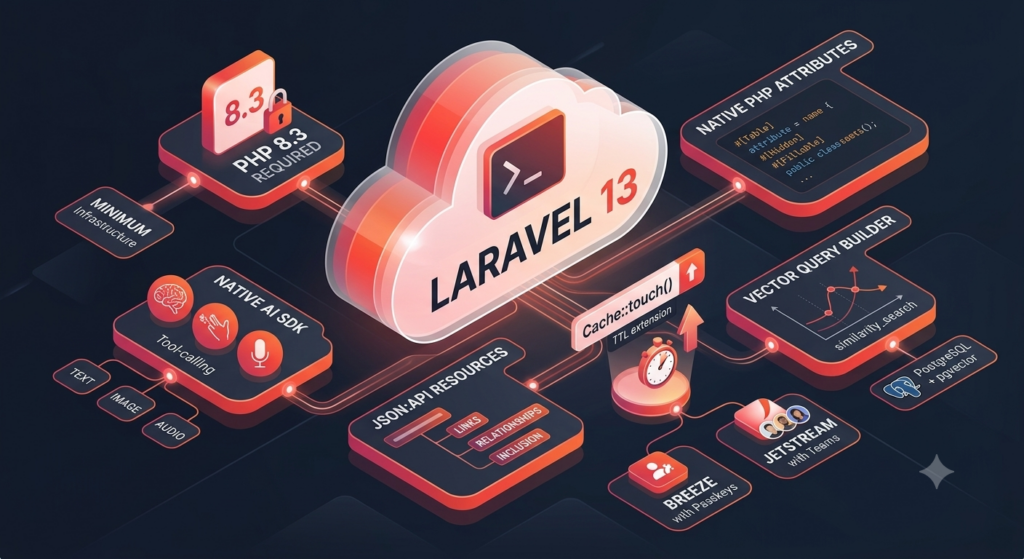
Laravel 13 continues that tradition by focusing on AI-native development, modern PHP capabilities, improved API support, enhanced security, better performance, and a seamless upgrade experience. Rather than introducing disruptive changes, Laravel 13 refines the framework with features that align with today’s application requirements—from AI integration and semantic search to passwordless authentication and modern PHP attributes.
In this guide, we’ll cover:
- What’s new in Laravel 13
- The biggest features introduced in this release
- Performance and security improvements
- AI-powered development with the official Laravel AI SDK
- Laravel 13 vs Laravel 12
- Why you should upgrade
- Who should use Laravel 13
What is Laravel 13?
Laravel 13 is the latest major release of the Laravel framework, designed to help developers build modern web applications with greater productivity and less complexity.
This release introduces several highly anticipated capabilities, including an official AI SDK, vector search support, expanded PHP Attribute usage, JSON:API resources, passkey authentication improvements, and numerous performance optimizations.
Built on PHP 8.3, Laravel 13 embraces modern PHP features while maintaining Laravel’s commitment to elegant syntax, readability, and minimal upgrade friction.
Why Laravel 13 Matters
Modern applications demand more than traditional CRUD functionality. AI-powered experiences, semantic search, secure authentication, standardized APIs, and scalable background processing have become common requirements across SaaS platforms, enterprise applications, and startups.
Laravel 13 addresses these evolving needs by providing first-party support for AI services, improving API development, embracing modern PHP features, and strengthening performance and security—allowing developers to focus more on building features and less on framework configuration.
What’s New in Laravel 13?
1. Official Laravel AI SDK
One of the biggest additions in Laravel 13 is the official Laravel AI SDK, providing a unified interface for integrating multiple AI providers.
Supported providers include:
- OpenAI
- Anthropic
- Google Gemini
- Other compatible AI providers
Instead of installing separate SDKs for each provider, developers can use a consistent Laravel API to build AI-powered features.
Example
use Laravel\AI\Facades\AI;

$response = AI::text()
    ->prompt('Write a welcome email for a new customer.')
    ->generate();

echo $response->text();
Benefits
- Unified API across providers
- Easy provider switching
- Built-in retry handling
- Queue integration
- Faster AI development
Perfect for chatbots, content generation, summarization, recommendation engines, and intelligent assistants.
2. Expanded PHP Attributes Support
Laravel 13 embraces modern PHP by expanding support for PHP Attributes, reducing boilerplate configuration and improving code readability.
Before
class ProcessOrder implements ShouldQueue
{
    public $tries = 3;
}
After
#[Tries(3)]
class ProcessOrder implements ShouldQueue
{
}
Attributes are now supported across various Laravel components, including:
- Queue Jobs
- Events
- Middleware
- Routes
- Artisan Commands
- Models
This results in cleaner, more expressive code that aligns with modern PHP development.
3. First-Class JSON:API Resources
Laravel 13 introduces native support for JSON:API Resources, making it easier to build standardized REST APIs.
Instead of manually formatting API responses, developers can use dedicated resource classes that follow the JSON:API specification.
Benefits
- Standardized API responses
- Better frontend integration
- Improved consistency
- Easier mobile application development
4. Semantic (Vector) Search
Traditional search relies on keyword matching, while Laravel 13 introduces support for semantic search using vector embeddings.
Rather than matching exact words, applications can now search based on meaning and context.
Example
Product::whereVectorSimilarTo(
    'embedding',
    $queryEmbedding
);
Common Use Cases
- AI-powered search
- Product recommendations
- Knowledge bases
- Document search
- Customer support portals
When paired with PostgreSQL and pgvector, Laravel applications can deliver significantly smarter search experiences.
5. PHP 8.3 Requirement
Laravel 13 now requires PHP 8.3 or later, allowing the framework to leverage the latest language improvements.
Benefits include:
- Better runtime performance
- Improved type safety
- Enhanced security
- Modern PHP language features
6. Queue System Improvements
Queues are essential for handling background jobs such as emails, notifications, report generation, and AI processing.
Laravel 13 improves queue performance and reliability with enhancements that make asynchronous processing more efficient.
Improvements
- Better worker performance
- Improved job routing
- Enhanced reliability
- More scalable background processing
7. Cache Enhancements
Laravel 13 introduces the new Cache::touch() helper.
Cache::touch('user:1');Instead of rewriting cached data, developers can simply refresh the cache expiration time.
Ideal for:
- User sessions
- Frequently accessed data
- Sliding expiration strategies
8. Improved Security Defaults
Security continues to be a major focus in Laravel 13.
This release introduces stronger default security configurations and authentication improvements to help developers build more secure applications with less manual configuration.
Highlights include:
- Improved authentication defaults
- Stronger framework security
- Better protection against common vulnerabilities
9. Enhanced Passkey Authentication
Laravel 13 expands support for Passkeys, enabling passwordless authentication using modern authentication methods.
Supported authentication includes:
- Face ID
- Touch ID
- Windows Hello
- Hardware security keys
Passkeys improve both user experience and protection against phishing attacks.
10. Performance Improvements
Laravel 13 includes numerous performance optimizations across the framework.
These improvements affect:
- HTTP Client
- Database operations
- Cache system
- Queue workers
- Internal framework components
Although many of these optimizations occur behind the scenes, they contribute to faster response times and improved scalability.
Laravel 13 vs Laravel 12
| Feature | Laravel 12 | Laravel 13 |
|---|---|---|
| PHP Requirement | PHP 8.2+ | PHP 8.3+ |
| Official AI SDK | ❌ | ✅ |
| JSON:API Resources | ❌ | ✅ |
| Semantic Search | ❌ | ✅ |
| PHP Attributes | Limited | Expanded |
| Cache::touch() | ❌ | ✅ |
| Passkey Support | Basic | Enhanced |
| Queue Improvements | Standard | Improved |
| Performance | Good | Better |
| Upgrade Experience | Easy | Minimal Breaking Changes |
Advantages of Laravel 13
- AI-Ready Development — Build AI-powered features with the official Laravel AI SDK.
- Cleaner Code — Expanded PHP Attributes reduce boilerplate and improve readability.
- Smarter Search — Vector search enables semantic, AI-powered search experiences.
- Modern API Development — JSON:API Resources simplify standardized API responses.
- Improved Security — Better authentication and stronger default security settings.
- Higher Performance — Optimizations across queues, caching, HTTP, and database operations.
- Easy Upgrades — Minimal breaking changes make upgrading from Laravel 12 straightforward.
Who Should Upgrade to Laravel 13?
Laravel 13 is an excellent choice for:
- Laravel developers building new applications
- AI-powered SaaS products
- REST API development
- Enterprise web applications
- E-commerce platforms
- Startups adopting modern PHP practices
- Teams looking for improved performance and security
If your application is already running on Laravel 12, upgrading to Laravel 13 is relatively straightforward and provides immediate access to modern development capabilities.
Conclusion
Laravel 13 builds upon the strengths of previous releases by introducing practical, future-focused enhancements rather than disruptive changes. From the official Laravel AI SDK and semantic vector search to expanded PHP Attribute support, improved API resources, stronger security, and better overall performance, the framework continues to evolve alongside modern web development needs.
Whether you’re building an AI-powered SaaS platform, developing enterprise APIs, or launching your next startup, Laravel 13 provides the tools to create scalable, secure, and maintainable applications with greater efficiency.
Final Thoughts
Laravel has always focused on making developers more productive, and Laravel 13 continues that mission with features that embrace AI, modern PHP standards, and high-performance application development. With minimal upgrade effort and powerful new capabilities, Laravel 13 is a compelling upgrade for existing projects and an excellent foundation for your next Laravel application.
Note: Before publishing, verify each feature against the official Laravel 13 release notes and upgrade guide, as some capabilities (particularly AI-related features) may evolve in subsequent minor releases or may require additional Laravel packages depending on your project setup.