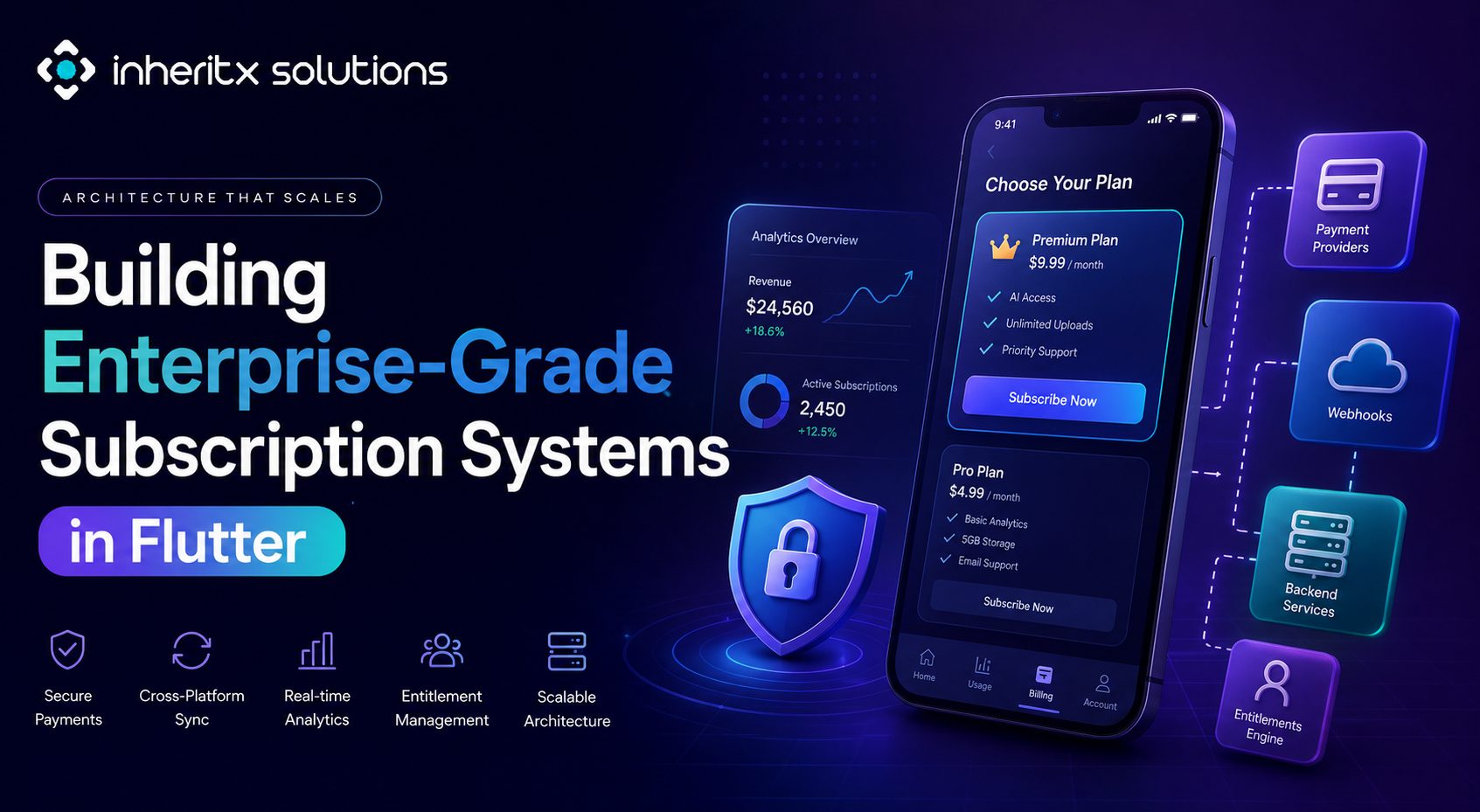
Building Enterprise-Grade Subscription Systems in Flutter
Architecture patterns, real-world challenges, and scalable design principles that go beyond simple in-app purchases.
Mobile subscriptions look deceptively simple in the early stages of product development.
A couple of plans, a purchase button, restore purchases support, and maybe a backend API to verify active users. For many MVPs, that setup works well enough.
The complexity starts later.
A failed renewal arrives late from the billing provider. A user purchases on iOS but expects premium access on Android. The pricing model changes from service-based plans to tier-based subscriptions. Refund events arrive out of order. Entitlements remain active even after cancellation.
At that point, the subscription system stops being a simple billing integration and starts behaving more like a distributed system synchronization problem.
In this article, we’ll look beyond basic in-app purchase implementation and focus on how enterprise-grade subscription systems can be designed in Flutter applications to remain scalable, maintainable, and reliable in production environments.
Why Subscription Systems Become Difficult at Scale
Most tutorials focus on completing a purchase flow successfully. Production systems, however, spend most of their time handling edge cases.
Some of the most common problems usually appear only after the application starts scaling:
|
1
State Mismatch
Subscription state often differs between the app, backend, and billing provider.
|
2
Delayed Webhooks
Events can arrive late, out of order, or even be retried multiple times.
|
3
Cross-Platform Sync
Users expect access on all devices, regardless of where they purchased.
|
4
Upgrades & Downgrades
Plan changes bring proration, partial refunds, and access transitions.
|
|
5
Restore Issues
Restore flows don’t always behave consistently across platforms.
|
6
Refund Reconciliation
Refunds can happen outside the app and must be reconciled.
|
7
Grace Periods
Billing retries and grace periods require accurate entitlement handling.
|
8
Multiple Sessions
Active sessions on multiple devices create consistency challenges.
|
A key realization: Billing providers are eventually consistent systems. Store events, webhook retries, and client-side refresh cycles rarely happen in perfect sync.
This means subscription systems must be designed to tolerate temporary inconsistencies instead of assuming everything updates instantly.
A Better Enterprise Subscription Architecture
Instead of treating subscriptions as a frontend concern, scalable systems move subscription ownership to the backend.
|
📱
Flutter App
Display state
Trigger purchase Sync entitlements |
→ |
🛒
Billing SDK
RevenueCat /
Native Billing Purchase handling |
→ |
🏪
App Store /
Play Store Payment processing
Subscription lifecycle |
→ |
🔔
Webhook
Events Purchase, renewal,
cancellation, refund events |
→ |
💻
Backend
Subscription Service Event processing
State management Reconciliation |
→ |
🛡
Entitlement
Engine Calculate access
Manage rules Generate entitlements |
|
i
|
The backend becomes the single source of truth for subscription state and entitlements. |
Flutter App
The mobile application should primarily focus on displaying subscription state, triggering purchases, syncing user entitlements, and handling the local offline experience. The app should not become the primary source of truth for subscription validation.
Billing Provider
Services like RevenueCat simplify many cross-platform billing problems including purchase restoration, receipt validation, cross-platform subscriptions, store integration, and subscription lifecycle events. However, even with managed billing platforms, backend synchronization still remains critical.
Backend Subscription Service
This layer becomes the heart of the subscription system. Its responsibilities include processing webhook events, maintaining subscription lifecycle state, handling retries and reconciliation, tracking cancellations and renewals, centralizing audit logs, and calculating active entitlements.
A very common mistake is relying entirely on client-side subscription state without backend reconciliation. That approach usually fails once real production edge cases begin appearing.
Separating Billing From Entitlements
One of the most scalable architectural decisions is separating payment plans from feature access.
|
Gold Plan
$9.99 / month
• Monthly billing
• Auto-renewal
• Multi-platform
|
Entitlements
✓ AI Access
✓ Advanced Analytics
✓ Unlimited Uploads
✓ Custom Templates
✓ Priority Support
✓ Team Collaboration
|
★ Key Insight
Instead of checking whether a user has “Gold Plan,” the system checks whether the user has specific entitlements. |
This approach creates flexibility to change pricing models, run promotions, grant temporary access, or introduce enterprise custom plans without rewriting feature logic.
Designing an Entitlement Engine
As products evolve, subscription systems often become more dynamic than initially expected. This is why enterprise systems often introduce a dedicated entitlement engine.
|
From Simple Plans
• Free
• Pro
• Premium
|
To Dynamic Access Models
✓ Team plans
✓ Trial extensions
✓ Feature add-ons
✓ Promotional access
✓ AI credit systems
✓ Regional pricing variations
|
A dedicated entitlement engine helps manage these complexities while keeping the mobile app clean and focused. |
Handling Event Synchronization Correctly
Subscription systems are highly event-driven by nature. The difficult part is that these events do not always arrive sequentially. Webhook delivery delays, duplicate events, and retry attempts are all normal.
|
Subscription Events
→Purchase events
→Renewal events
→Cancellation events
→Refund events
→Billing retry states
→Grace period updates
|
Required Protections
✓Idempotency
✓Retry-safe processing
✓Event timestamps
✓Audit logging
✓Reconciliation jobs
|
Without these protections, subscription state drift becomes very difficult to debug.
Why Backend Should Be the Source of Truth
The app should display subscription state. The backend should own subscription state.
This distinction becomes critical once multiple devices and platforms are involved. Consider: a user purchases on iPhone, logs into their Android device, the subscription renews while the app is closed, and a refund gets processed externally. The frontend alone cannot reliably coordinate these scenarios — a centralized backend service can.
This also improves security, analytics, fraud prevention, cross-platform consistency, and subscription recovery.
Flutter Client Architecture Considerations
On the Flutter side, subscription management should remain modular and isolated from UI components. A common scalable structure is:
↓
Subscription Controller / Bloc / Riverpod
↓
Subscription Repository
↓
Billing SDK + Backend APIs
|
Architecture Benefits
→Avoids tight coupling to widgets
→Isolated business logic
→Testable layer structure
→Centralized access guards
|
Production Considerations
✓Cache entitlements for offline access
✓Background subscription refresh
✓Restore purchase recovery flows
✓Graceful handling of stale states
|
Common Mistakes We Often See
Many subscription systems become difficult to maintain because of a few early architectural shortcuts. Most work temporarily during MVP stages — the problems appear later during scale, migrations, or cross-platform expansion.
|
!
Trusting Local State
Relying on local purchase state without backend verification.
|
!
Hardcoding Plan IDs
Placing plan IDs directly into UI logic instead of backend-driven entitlements.
|
!
Skipping Webhooks
Skipping reconciliation leads to state drift and silent failures.
|
|
!
Mixed Logic
Mixing entitlement logic with payment logic reduces maintainability.
|
!
No Migration Plan
Not planning for future pricing migrations causes painful rewrites.
|
!
Assuming Instant Events
Assuming store events always arrive instantly breaks under real conditions.
|
The Future of Subscription Systems
Subscription models are becoming far more dynamic than traditional monthly plans. Because of this shift, flexible architecture matters more than ever. Systems designed around static plan checks often struggle to adapt to newer monetization models.
| Usage-based billing | Feature-level monetization | AI credit consumption |
| Team-based licensing | Hybrid subscription models | Dynamic entitlement config |
Final Thoughts
At small scale, subscription systems can appear deceptively simple.
At production scale, they become deeply connected to distributed systems behavior, backend synchronization, entitlement calculation, and long-term product evolution.
The teams that avoid major subscription-related issues are usually the ones that treat subscriptions as an architectural domain — not just a billing integration.
Flutter makes building purchase flows relatively straightforward. Designing a subscription system that remains reliable through pricing changes, platform expansion, edge cases, and business evolution is the part that requires real engineering discipline.