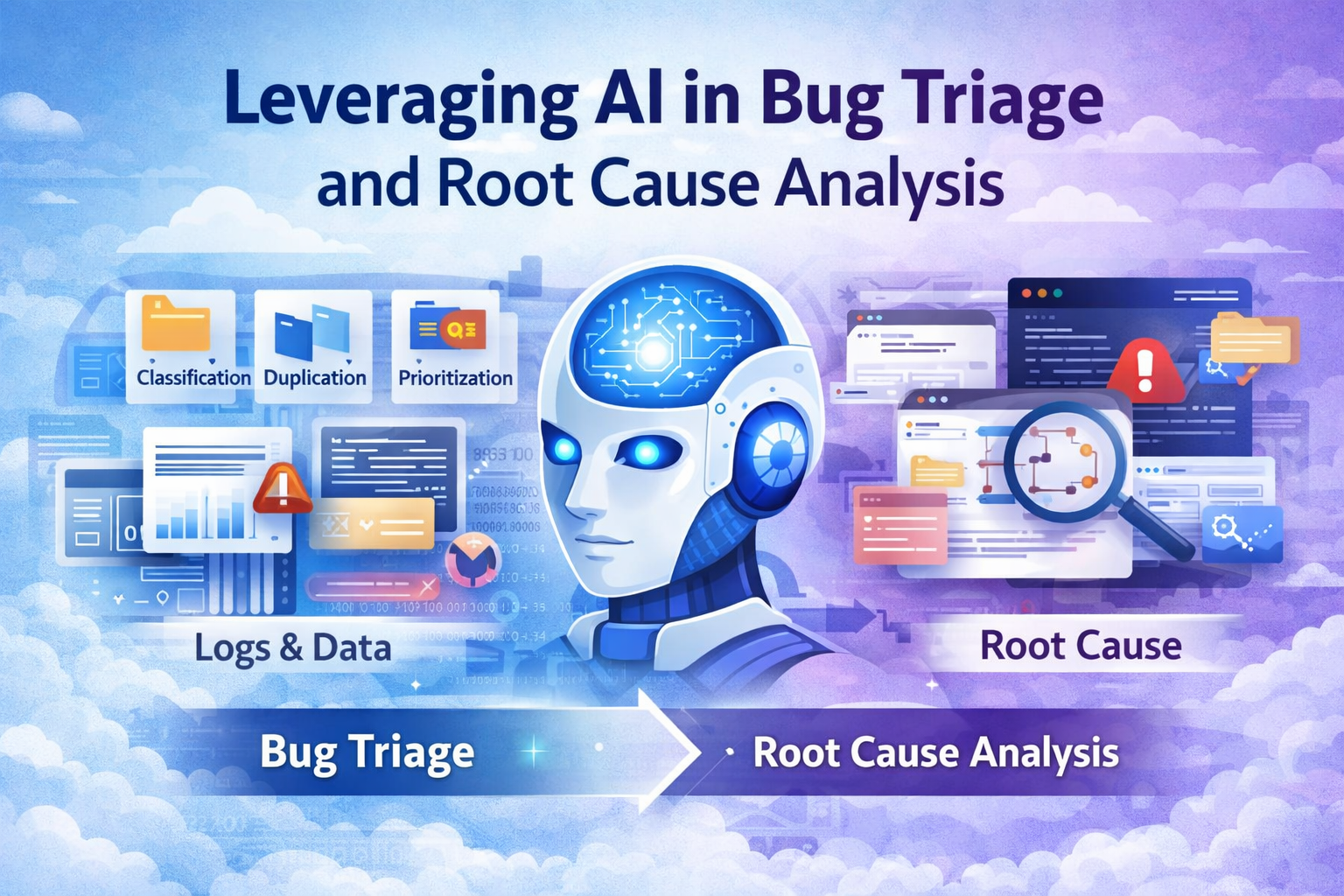
Modern software systems are increasingly complex, involving distributed architectures, microservices, and continuous delivery pipelines. As systems scale, so does the volume of bugs, alerts, and incidents. Traditional approaches to bug triage and root cause analysis (RCA) often struggle to keep pace with this complexity.
Artificial Intelligence (AI) offers a way to improve efficiency, accuracy, and speed across these processes.
Limitations of Traditional Bug Triage
Conventional bug triage methods present several challenges:
- Manual classification and prioritization require significant time and effort
- Duplicate bug reports create unnecessary noise
- Large volumes of logs make it difficult to isolate meaningful signals
- Root cause identification can be slow and inconsistent
These issues can lead to delayed resolutions, increased downtime, and reduced productivity.
Role of AI in Bug Triage
AI techniques can enhance multiple stages of the triage process:
Automated Classification
AI models can analyze bug descriptions and automatically categorize them by type, such as user interface, backend, database, or performance-related issues. They can also assign severity levels based on learned patterns.
Duplicate Detection
Natural Language Processing (NLP) enables AI systems to identify semantically similar bug reports, even when phrased differently. This helps consolidate duplicate entries and maintain a cleaner backlog.
Prioritization
AI can evaluate factors such as user impact, frequency, and business relevance to rank bugs effectively. This ensures that critical issues are addressed first.
Intelligent Assignment
By analyzing historical data, AI can route bugs to the most appropriate team or developer based on expertise and past contributions.
AI in Root Cause Analysis
Root cause analysis is often time-intensive. AI can significantly streamline this process:
Log and Data Analysis
AI systems can process large volumes of logs and telemetry data, identifying anomalies and correlating events across different services.
Pattern Recognition
Machine learning models can detect recurring failure patterns and match them with previously known issues, reducing investigation time.
Causal Analysis
Advanced models can identify relationships between system events, helping trace the sequence of failures that led to an incident.
Predictive Insights
AI can anticipate potential failures by recognizing early warning signals, enabling proactive mitigation.
Applications
AI-driven bug triage and RCA are applicable across various domains:
- DevOps and Site Reliability Engineering (SRE) for incident management
- Large-scale software platforms handling high volumes of issues
- Customer support systems that integrate with engineering workflows
Techniques Commonly Used
- Natural Language Processing for analyzing bug reports
- Machine Learning for classification and prediction
- Anomaly detection for identifying irregular system behavior
- Graph-based approaches for modeling service dependencies
Benefits
- Reduced time spent on manual triage
- Improved accuracy in classification and prioritization
- Faster identification of root causes
- Decreased duplication of issues
- Enhanced system reliability
Challenges
Despite its advantages, AI adoption in this area involves certain considerations:
- Dependence on high-quality historical data
- Need for continuous model training and validation
- Possibility of incorrect predictions
- Integration with existing tools and workflows
Future Outlook
AI is expected to play a growing role in software maintenance and operations. Emerging directions include automated remediation, intelligent debugging assistants, and deeper integration with observability platforms.
Conclusion
AI enhances bug triage and root cause analysis by automating repetitive tasks and providing data-driven insights. While it does not replace engineering expertise, it supports more efficient workflows and faster issue resolution, making it a valuable addition to modern software development practices.