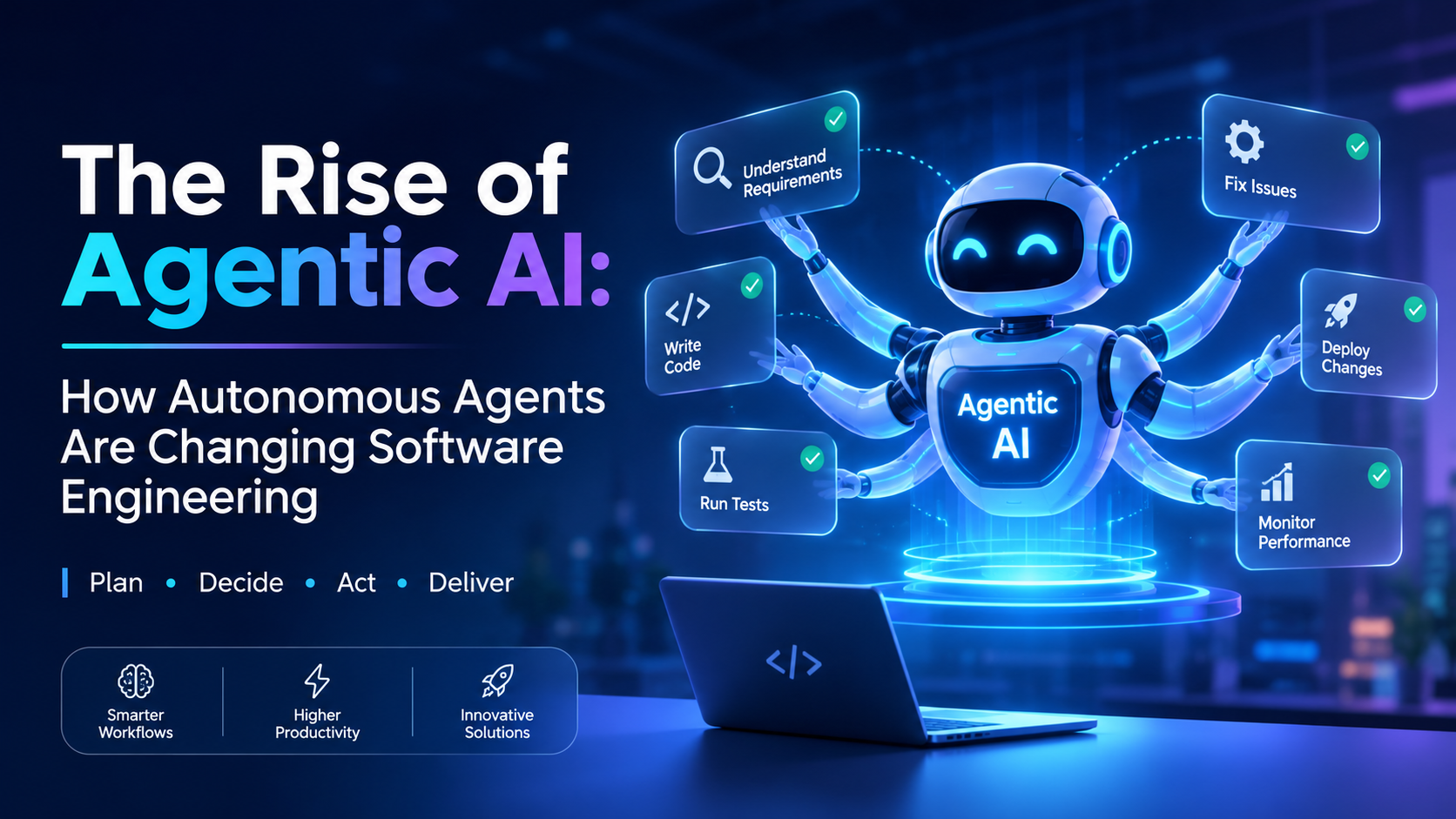
Introduction
Artificial Intelligence has already transformed the way software is developed. From intelligent code completion and automated documentation to debugging assistance and test generation, AI-powered tools have become an increasingly important part of modern software engineering.
However, we are now entering a new phase of this evolution.
Instead of simply responding to questions, suggesting code, or performing isolated tasks, AI systems are becoming capable of understanding objectives, creating plans, executing actions, evaluating results, and adapting their approach based on feedback.
This emerging approach is known as Agentic AI.
Agentic AI represents a significant shift from AI that simply assists developers to AI systems that can actively participate in software engineering workflows. These systems can interact with development environments, analyze codebases, execute commands, run tests, investigate errors, and coordinate multiple activities to achieve a defined objective.
But what does this mean for the future of software engineering? Will developers eventually delegate entire development workflows to AI agents? And how can organizations take advantage of this technology while maintaining code quality, security, and reliability?
Let’s explore how Agentic AI works, where it is making an impact, and what it means for the next generation of software development.
1. What Is Agentic AI?
Agentic AI refers to AI systems designed to pursue specific goals by independently planning and executing a sequence of actions.
Unlike traditional AI assistants, which generally wait for instructions and return a response, agentic systems can operate through iterative workflows. They understand an objective, determine the steps required to achieve it, interact with external tools, and evaluate whether the desired outcome has been achieved.
An AI agent can perform several activities, including:
- Understanding high-level requirements and objectives.
- Breaking complex problems into smaller tasks.
- Creating execution plans and identifying dependencies.
- Interacting with APIs, databases, development tools, and external systems.
- Executing commands and modifying files.
- Evaluating results and identifying errors.
- Adjusting its approach when something goes wrong.
- Requesting human intervention when approval or additional information is required.
For example, consider a developer asking an AI assistant:
“Fix the authentication issue in our application.”
A traditional AI assistant might analyze the problem and suggest possible code modifications.
An agentic AI system could take the task further:
- Inspect the project structure and identify authentication-related modules.
- Analyze the existing authentication implementation.
- Examine error logs and identify potential problems.
- Modify the relevant implementation.
- Run unit tests and integration tests.
- Analyze test failures and attempt necessary corrections.
- Summarize the changes and prepare a pull request for developer review.
The key difference is that the agent is not simply generating code. It is working toward a defined objective through multiple connected actions.
2. Agentic AI vs. Traditional AI Assistants
To understand the significance of Agentic AI, it is important to distinguish it from traditional AI-powered development assistants.
Traditional AI assistants primarily respond to individual prompts. They can explain concepts, generate code snippets, suggest fixes, and help developers solve specific problems.
Agentic AI extends these capabilities by allowing AI systems to plan and execute multi-step workflows.
Consider the following comparison:
| Capability | Traditional AI Assistant | Agentic AI |
|---|---|---|
| Understand instructions | Yes | Yes |
| Generate code | Yes | Yes |
| Analyze project files | Tool-dependent | Can inspect connected repositories |
| Break tasks into steps | Usually user-directed | Can plan independently |
| Execute commands | Usually limited | Can use configured tools |
| Run automated tests | May suggest tests | Can execute and analyze tests |
| Investigate errors | Suggests possible solutions | Can investigate and attempt corrections |
| Coordinate multiple tasks | Limited | Can orchestrate workflows |
| Complete development workflows | Requires frequent interaction | Can handle multiple steps autonomously |
The distinction is not absolute. Modern AI assistants increasingly include agentic capabilities. The difference lies in the level of autonomy, tool access, planning, and execution available to the system.
3. How Does Agentic AI Work?
An agentic AI system typically combines several components that allow it to understand objectives, make decisions, interact with external systems, and evaluate outcomes.
A. Large Language Models (LLMs)
Large Language Models act as the reasoning and language-processing foundation of many AI agents.
They help agents understand instructions, interpret context, generate plans, and determine appropriate actions.
B. Planning and Reasoning
Once an objective is provided, the agent breaks it down into smaller, manageable tasks.
For example, implementing a new payment feature might involve:
- Understanding the business requirements.
- Identifying the relevant application modules.
- Reviewing existing payment integrations.
- Implementing the required functionality.
- Handling error scenarios.
- Creating and executing tests.
The planning component determines how these tasks should be performed and in what order.
C. Memory and Context Management
Agents need access to relevant information to perform tasks effectively.
This may include project documentation, source code, previous interactions, execution history, and existing business rules.
Memory and context management help agents maintain continuity across multi-step workflows and avoid repeatedly gathering the same information.
D. Tool Integration
One of the most important capabilities of Agentic AI is its ability to interact with external tools and systems.
Through APIs, command-line interfaces, IDE integrations, and protocols such as the Model Context Protocol (MCP), agents can interact with:
- Git repositories and version control systems.
- Development environments and terminals.
- Databases and REST APIs.
- Testing frameworks.
- CI/CD pipelines.
- Issue tracking and project management platforms.
This allows agents to move beyond generating recommendations and actually perform configured development activities.
E. Execution and Feedback Loop
After performing an action, the agent evaluates the result.
If the operation fails, the agent can analyze the error, revise its approach, and attempt another solution.
For example, if an agent modifies a function but the unit tests fail, it can inspect the test output, identify the issue, update the implementation, and execute the tests again.
This creates an iterative cycle:
Understand → Plan → Execute → Evaluate → Adapt
The cycle continues until the task reaches an acceptable outcome, an execution limit is reached, or human intervention becomes necessary.
4. How Agentic AI Is Transforming Software Engineering
Agentic AI has the potential to influence almost every stage of the software development lifecycle.
A. Automated Code Development
AI agents can analyze existing repositories, understand project conventions, implement new functionality, and modify multiple files.
Instead of asking an AI tool to generate an isolated function, developers can assign it a complete development task.
For example:
“Implement a profile management feature with profile editing, image upload, API integration, input validation, and unit tests.”
An agent can inspect the existing architecture, identify reusable components, implement the required changes, and execute relevant tests.
This can reduce repetitive implementation work and allow developers to spend more time on architectural decisions, business logic, and complex engineering challenges.
B. Intelligent Debugging and Bug Resolution
Debugging is often one of the most time-consuming activities in software development.
An agent can analyze error logs, inspect stack traces, review related source files, and investigate potential causes.
It can also:
- Reproduce reported issues in a controlled environment.
- Identify potentially affected modules.
- Suggest or implement fixes.
- Execute regression tests.
- Summarize the root cause and proposed resolution.
Rather than simply explaining an error, the agent can participate in the entire investigation and resolution process.
C. Automated Testing and Quality Assurance
Testing is another area where agentic workflows offer significant potential.
Agents can analyze requirements, generate test cases, execute automated tests, interpret failures, and suggest improvements.
For example, when a new login feature is implemented, an agent could help validate:
- Successful authentication.
- Invalid credentials.
- Empty input fields.
- Network failures.
- Token expiration.
- Session management.
- Unexpected API responses.
This creates a more connected development and testing workflow.
However, generated tests still require meaningful assertions and independent validation. A passing test suite does not automatically guarantee that the implementation is correct.
D. Code Review and Security Analysis
AI agents can assist with pull request reviews by examining code changes, identifying potential vulnerabilities, and checking adherence to project standards.
They can flag issues such as:
- Hardcoded credentials.
- Insecure API communication.
- Improper input validation.
- Potential memory leaks.
- Unnecessary dependencies.
- Missing error handling.
- Inadequate test coverage.
Agents can also integrate with static analysis and dependency scanning tools to improve the review process.
Human reviewers should continue to own important architectural, security, and business decisions.
E. CI/CD and DevOps Automation
Agentic AI can extend beyond writing code into the software delivery lifecycle.
With appropriate permissions, agents can help investigate failed builds, analyze deployment logs, identify configuration problems, and recommend corrective actions.
For example, when a CI/CD pipeline fails, an agent could:
- Inspect the build logs.
- Identify the failing stage.
- Analyze the error.
- Check relevant configuration files.
- Propose a correction.
- Run the pipeline again in an approved environment.
This creates opportunities for more intelligent and responsive development operations.
5. Single-Agent vs. Multi-Agent Systems
As Agentic AI evolves, another interesting development is the emergence of multi-agent systems.
A single AI agent can handle multiple tasks, but complex projects may benefit from multiple specialized agents working together.
Consider a software development workflow involving four specialized agents:
Planning Agent: Understands requirements, identifies dependencies, and breaks the work into smaller tasks.
Development Agent: Implements functionality, modifies code, and integrates the required components.
Testing Agent: Generates test cases, executes tests, and identifies potential failures.
Review Agent: Examines code quality, security, architecture, and implementation standards.
A coordinating agent can assign work, share relevant context, collect results, and determine whether additional actions are required.
For example, when implementing a new user registration feature, the planning agent can identify the required activities, the development agent can implement the feature, the testing agent can validate different registration scenarios, and the review agent can examine the final changes.
This approach can improve workflow organization when tasks are clearly separated and can be independently validated.
However, introducing multiple agents does not automatically improve performance. Coordination overhead, duplicated work, conflicting changes, and additional execution costs must also be considered.
6. Popular Technologies Driving Agentic Software Development
The agentic development ecosystem is evolving rapidly. Several technologies and platforms are helping developers build and use these workflows.
Claude Code
Claude Code is an agentic coding tool from Anthropic that can understand codebases, edit files, execute commands, and assist with complex development tasks.
It helps developers work with existing repositories and delegate implementation activities through a terminal-based workflow.
Website: https://www.anthropic.com/claude-code
OpenAI Codex
OpenAI Codex provides AI-powered software engineering capabilities that allow developers to delegate coding tasks to AI agents.
It can work with repositories and development environments to assist with implementation, debugging, and other engineering activities.
Website: https://openai.com/codex/
GitHub Copilot
GitHub Copilot provides AI-powered coding assistance and agentic development capabilities integrated into developer workflows.
It helps developers understand code, generate implementations, make changes, and work with development tasks.
Website: https://github.com/features/copilot
LangChain
LangChain provides frameworks and tools for building applications powered by large language models.
It supports the development of AI agents, tool integrations, and workflows that connect language models with external systems.
Website: https://www.langchain.com/
CrewAI
CrewAI is a framework focused on orchestrating multiple specialized AI agents that collaborate to accomplish complex objectives.
Developers can define agent roles, tasks, and collaboration workflows to build multi-agent applications.
Website: https://www.crewai.com/
Model Context Protocol (MCP)
Model Context Protocol is an open protocol that provides a standardized way for AI applications to connect with external tools and data sources.
It makes it easier to integrate AI systems with databases, APIs, development environments, and other services.
Website: https://modelcontextprotocol.io/
These technologies serve different purposes. Some provide ready-to-use coding agents, while others help developers build and orchestrate custom agentic systems.
7. Benefits of Agentic AI in Software Engineering
When implemented with appropriate workflows and safeguards, Agentic AI can offer several advantages.
Increased Developer Productivity
Automating repetitive implementation, testing, and debugging activities allows developers to focus on higher-value engineering work.
Faster Development Cycles
Agents can perform multiple connected tasks without requiring constant manual instructions, potentially reducing the time required to move from requirements to implementation.
Improved Consistency
Project-specific instructions, reusable workflows, and automated validation can help maintain coding standards and implementation practices.
Better Development Support
Agents can help developers navigate unfamiliar repositories, understand complex implementations, investigate technical issues, and work with existing documentation.
Scalable Automation
Organizations can automate selected workflows across multiple projects without requiring developers to manually perform every intermediate activity.
However, productivity improvements are not guaranteed. Actual results depend on task complexity, repository quality, tool reliability, review requirements, and how effectively the workflow is designed.
8. Challenges and Risks of Agentic AI
Despite its potential, Agentic AI introduces new engineering challenges that organizations must address before adopting it at scale.
A. Incorrect Decisions and Hallucinations
AI agents can misunderstand requirements, generate incorrect code, or make assumptions that do not match the intended business logic.
Because agents can execute multiple actions, an incorrect assumption can propagate across several stages of a workflow.
B. Security and Access Control
Agents may require access to source code, terminals, databases, APIs, and deployment environments.
Giving an agent excessive permissions can introduce serious security risks.
Organizations should follow the principle of least privilege, isolate execution environments where appropriate, and restrict access to sensitive operations.
C. Unpredictable Execution
Unlike traditional deterministic automation, LLM-based agents can produce different execution paths for similar inputs.
An agent may retry unnecessarily, select an unsuitable tool, or fail to recognize that a task is complete.
Execution limits, structured outputs, validation rules, and monitoring are therefore important.
D. Code Quality and Maintainability
AI-generated code may work for an immediate requirement but still introduce architectural inconsistencies, duplicated logic, or long-term maintenance problems.
Human code reviews, automated quality checks, and adherence to established engineering practices remain essential.
E. Cost and Resource Consumption
Agentic workflows may involve multiple model calls, repeated execution cycles, tool integrations, and large context windows.
Without proper optimization, complex tasks can become expensive and slow.
Organizations need to monitor resource consumption and establish execution budgets.
F. Accountability and Governance
Organizations need clear ownership of AI-generated changes.
Some important questions include:
- Who approves code generated by an agent?
- Who is responsible when an agent introduces a production issue?
- Which actions require explicit human approval?
- How are agent activities logged and audited?
- How is sensitive project information protected?
These considerations become increasingly important as agents receive greater autonomy.
9. Best Practices for Implementing Agentic AI
For organizations planning to introduce agentic AI into their software development processes, adopting it gradually is generally better than immediately automating the entire development lifecycle.
Here are some recommended practices:
1. Start with Well-Defined Tasks
Begin with repetitive and clearly defined activities such as documentation generation, test creation, bug investigation, and code review assistance.
2. Apply the Principle of Least Privilege
Provide agents with only the permissions necessary to perform their assigned responsibilities.
Avoid giving unrestricted access to production systems, sensitive credentials, or critical infrastructure.
3. Maintain Human Oversight
Require developer approval for important code changes, security-sensitive modifications, infrastructure changes, and production deployments.
4. Integrate Automated Testing
Ensure that AI-generated changes pass appropriate unit tests, integration tests, static analysis, and other validation checks before acceptance.
5. Monitor Agent Activities
Maintain execution logs, track tool usage, monitor failures, and establish clear limits on the actions agents can perform.
6. Protect Sensitive Information
Use secure credential management, access controls, and appropriate data-handling policies when connecting agents to internal systems.
7. Measure Actual Productivity Improvements
Evaluate whether agentic workflows genuinely reduce development time, improve code quality, or reduce repetitive effort.
Once individual workflows become reliable, organizations can gradually expand the responsibilities assigned to AI agents.
The goal should not be to eliminate human involvement, but to create a development environment where humans and AI agents complement each other’s strengths.
10. What Does the Future Hold?
The evolution of Agentic AI could fundamentally change how software engineering teams are structured and how development work is distributed.
We may see a transition from developers manually executing every stage of development toward developers defining objectives, supervising intelligent systems, and validating outcomes.
Some emerging possibilities include:
Autonomous Feature Development
Agents may increasingly handle larger development tasks, from understanding requirements and implementing functionality to preparing reviewed pull requests.
Self-Healing Applications
AI systems could identify operational problems, investigate potential causes, and recommend or execute approved corrective actions.
Intelligent Development Teams
Multiple specialized agents may collaborate across development, testing, security, documentation, and deployment activities.
AI-Native Software Architecture
Applications may increasingly be designed from the beginning to incorporate AI-driven decision-making, intelligent automation, and agent-based interactions.
Continuous Software Improvement
Agents could analyze application feedback, performance metrics, error reports, and technical debt to identify opportunities for ongoing improvements.
However, fully autonomous software development remains an evolving goal. Reliability, verification, security, and accountability will determine how much responsibility these systems can safely take on.
The future is unlikely to be about AI replacing every developer. Instead, it will be about developers becoming more capable by working alongside increasingly intelligent systems.
Conclusion: The Developer’s Role Is Evolving
Agentic AI represents more than another advancement in AI-powered coding tools. It introduces a fundamental shift in how software engineering tasks can be approached.
Developers are moving beyond simply using AI to generate code. They are beginning to delegate objectives, orchestrate intelligent agents, and supervise automated workflows that span multiple stages of the software development lifecycle.
This does not make traditional software engineering principles less important. In fact, architecture, clean code, testing, security, and maintainability become even more critical when AI systems are capable of making and executing decisions.
Organizations that successfully combine AI-driven automation with strong engineering practices will be better positioned to improve development efficiency and build more intelligent software solutions.
The next evolution of software engineering is not just about writing code faster. It is about building systems that can understand objectives, take action, learn from feedback, and help deliver meaningful outcomes.
The developers who learn to work effectively with these systems will play an important role in shaping that future.
References and Further Reading
For readers interested in exploring Agentic AI and its applications in software engineering, the following resources provide additional technical information:
- Anthropic – Claude Code: https://www.anthropic.com/claude-code
- OpenAI – Codex: https://openai.com/codex/
- GitHub – Copilot: https://github.com/features/copilot
- LangChain – Documentation and Resources: https://www.langchain.com/
- CrewAI – Multi-Agent Framework: https://www.crewai.com/
- Model Context Protocol – Official Documentation: https://modelcontextprotocol.io/
- McKinsey – Technology Trends Outlook: https://www.mckinsey.com/capabilities/tech-and-ai/our-insights
Final Thought: Agentic AI is changing the relationship between developers and the tools they use. The opportunity is not simply to automate more tasks, but to rethink how software is designed, developed, tested, and delivered. The future of engineering will belong to teams that know how to combine human creativity, engineering expertise, and intelligent automation.